Published 5th October, 2026
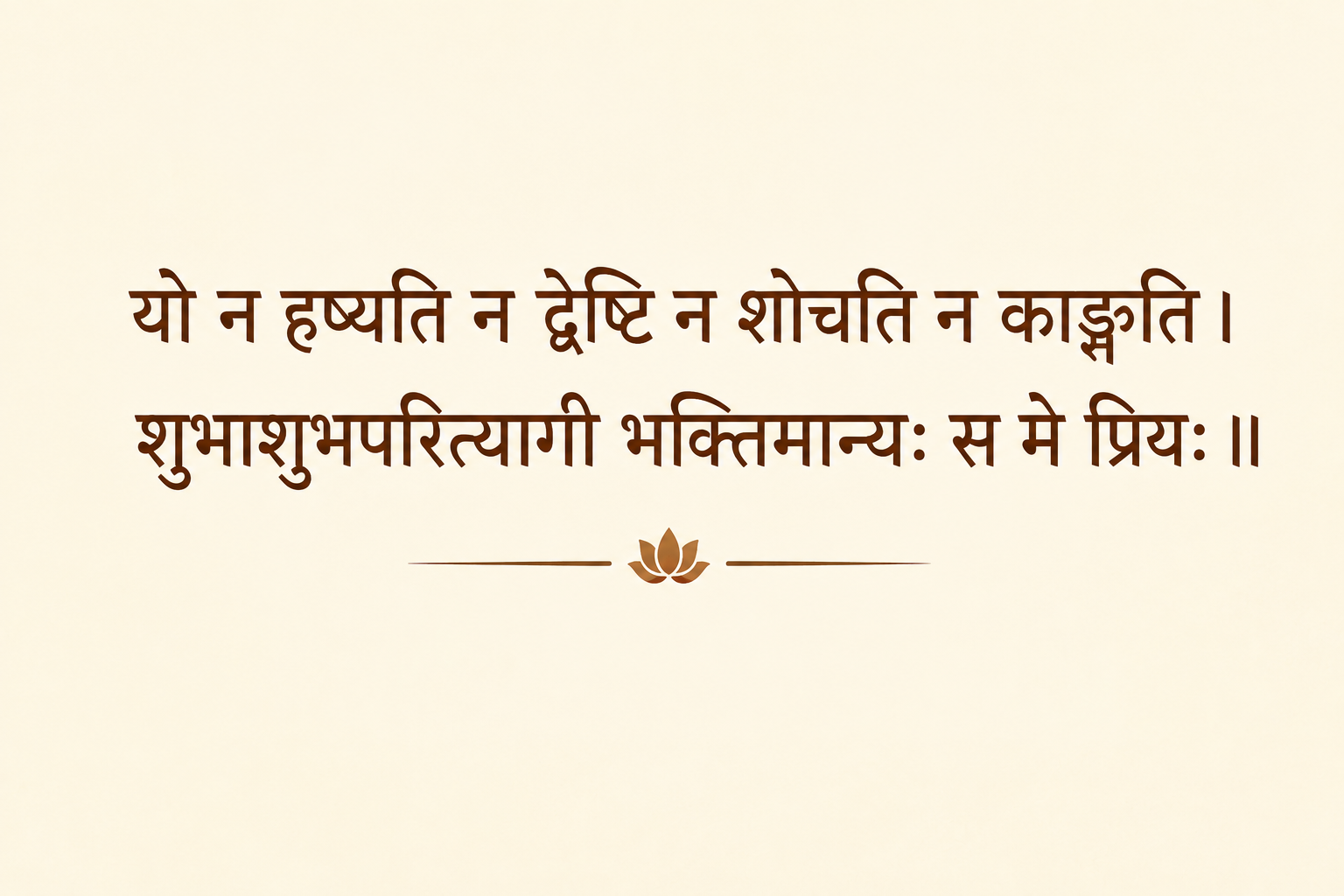
?? ? ??????? ? ???????? ? ????? ? ????????? ? ???????????????? ??????????? ? ?? ?????? ??
Meaning:
He who is not carried away by joy or filled with anger, sorrow, or passion; nor gets attached to pleasant or unpleasant experiences; is very dear to Me.
Essence:
This is because this verse speaks about one aspect that has become very rare in today's world - Balance. Krishna is not advocating a lack of feelings. He is teaching us to feel without becoming completely overwhelmed by those feelings.
Consider a young professional who gets a sudden promotion at her company. She is ecstatic, and why shouldn’t she be? But what happens if she ties her self-worth to this promotion and, the next year, someone else gets promoted over her? What if she is denied access to something and then she defines herself by this failure?
Another option in the Gita: Be passionate yet stay rooted.
The stanza flows through four intense states: h??yati (extreme happiness), dve??i (hatred), ?ocati (sadness), and k??k?ati (desire). All of them represent normal human emotions. Krishna teaches us not to be a slave to them.
Here is an amazing illustration: the ocean. Waves come and go endlessly on its surface, while the bottom stays calm. Our feelings are like waves: happiness arises; sadness arises; anger arises; desire arises. But they are just waves.
Detachment, therefore, does not imply becoming detached or cold. Detachment implies being able to detach and say, “Yes, I am feeling this emotion, but this emotion doesn’t define who I am.”
This is especially true for a world built on emotions. Achievement is made public. Failure is made public. Others' lives are put out there. The mind is never allowed just to be.
Balance becomes a kind of freedom.
Maybe the ultimate lesson lies in not letting go of the need to celebrate, grieve, or want. Instead, don't give every emotion the power to determine our self-worth and direction.
Celebrate your successes without becoming addicted to them. Accept failures without letting them determine who you are; love without becoming lost. Desire what you want without feeling that you can’t be complete without it.
This is the shloka's power, hidden in its silence.
A peaceful existence doesn’t mean living without emotional waves. It means knowing how to stay anchored through them.